
About products
Home / Q&A
-
How deep can a gun drill process?
In general, it can drill to a depth of about 50 to 100 times that of the hole diameter.
-
Can it process any type of material?
In addition to S45C and SCM materials, the gun drill is able to process a wide range of materials including SUS and aluminum materials. Depending on processing conditions, the drill is also able to process difficult-to-cut materials such as titanium alloys.
-
What type of shape does a gun drill have?
The gun drill consists of three main parts: an extra-hard blade, a shank, and a driver. The shank and extra-hard blade form a V-shaped cross section, with the shank being hollow.
Cutting oil flows through the inside of the drill and is injected from the oil holes on the edge of the cutting blade.
Since cutting-chips are discharged with the injected cutting oil to the back of the drill via the V-shape configuration of the cutter and shank, deep hole processing is able to be performed without the need of step feed processing.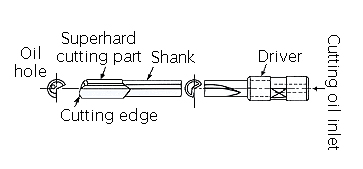
-
How is it different from a twist drill?
Twist drills need to perform deep hole processing via step feeding, and therefore, they require a large amount of processing tact time.
However, since gun drills can perform processing without step feeding, they are able to perform hole drilling with very high efficiency. -
What type of drill is a gun drill?
Unlike traditional processing methods, a gun drill does not step-feed difficult deep holes, but rather, carries out processing with a high degree of precision.